
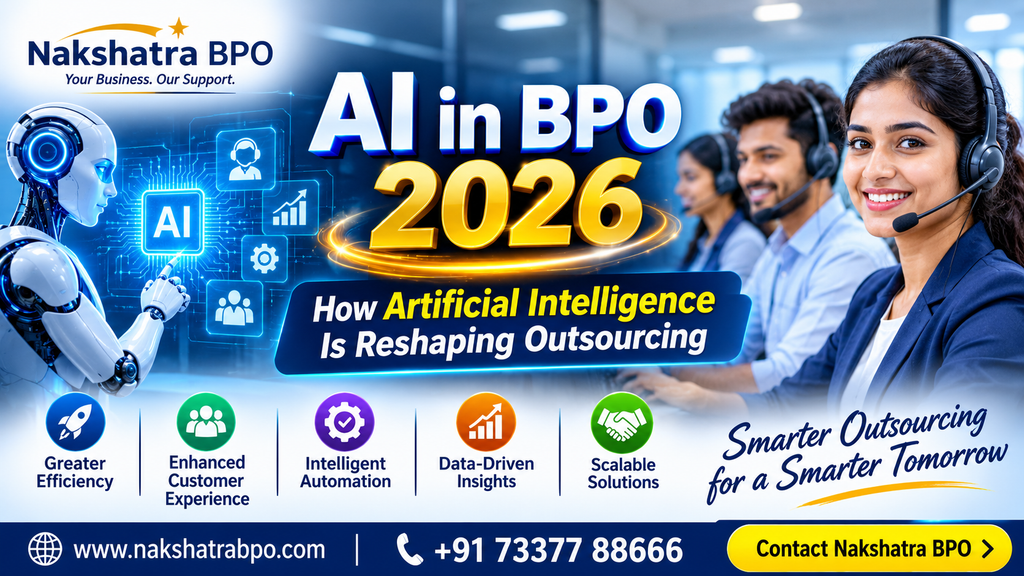
AI in BPO 2026: How Artificial Intelligence Is Reshaping Outsourcing
Discover AI in BPO 2026: How Artificial Intelligence Is Reshaping Outsourcing transforming outsourcing through automation, intelligent customer support, predictive analytics, and smarter business operations.
The Future of Outsourcing Has Arrived
Running a business in 2026 means managing increasing customer expectations, rising operational costs, and growing competition. Business owners need smarter ways to improve efficiency without compromising service quality. Whether companies are investing in customer support, digital operations, or marketing strategies such as Google Ads for business owners, technology has become essential for sustainable growth. This is where AI in BPO 2026 is making a significant difference.
Business Process Outsourcing (BPO) has evolved beyond traditional customer service and back-office operations. Artificial Intelligence (AI), machine learning, robotic process automation (RPA), and generative AI are transforming how outsourcing companies manage business processes, communicate with customers, analyze information, and deliver services.
Today, businesses no longer look at outsourcing simply as a way to reduce expenses. They expect faster responses, accurate results, personalized customer experiences, and measurable business outcomes.
But how exactly is AI changing the BPO industry? Can artificial intelligence replace traditional outsourcing operations? And how can business owners benefit from AI-powered BPO services?
Let’s explore how artificial intelligence is reshaping outsourcing in 2026 and what it means for the future of business.
What Is AI in BPO?
AI in Business Process Outsourcing (BPO) refers to the use of artificial intelligence technologies to automate, improve, and manage business operations traditionally performed by human employees.
These technologies help BPO companies process information, understand customer requests, automate repetitive activities, predict business trends, and support employees in delivering better services.
Common AI technologies used in BPO include:
- Machine Learning (ML): Identifies patterns in business data and improves predictions.
- Natural Language Processing (NLP): Helps AI understand and respond to human language.
- Generative AI: Creates content, summarizes conversations, and assists customer service teams.
- Robotic Process Automation (RPA): Automates repetitive, rule-based business tasks.
- AI Chatbots and Virtual Assistants: Handle common customer questions and requests.
- Agentic AI: Uses AI agents to plan and execute certain multi-step workflows within defined permissions.
Together, these technologies are changing traditional outsourcing into intelligent, data-driven business operations.
Quick Answer: How Is AI Transforming BPO in 2026?
AI in BPO 2026 is transforming outsourcing by automating repetitive tasks, improving customer support, reducing response times, analyzing business data, and helping employees make faster decisions. AI-powered chatbots, intelligent automation, predictive analytics, and agent-assist systems allow BPO companies to deliver scalable, efficient, and personalized services while human professionals handle complex customer needs and decision-making.
1. AI-Powered Customer Support Is Transforming Customer Experience
Customer experience is one of the most important factors influencing business success. Customers expect quick responses, accurate information, and consistent support across different communication channels.
Traditional customer support operations can struggle with high call volumes, repetitive queries, and long waiting times.
AI is helping BPO companies address these challenges.
How AI improves customer support
24/7 customer assistance
AI-powered chatbots and virtual assistants can answer common questions at any time, including outside regular business hours.
Faster query resolution
AI can identify customer intent and retrieve relevant information, helping customers find answers more quickly.
Multichannel communication
AI-enabled customer support can operate across phone, email, live chat, and messaging channels.
Intelligent call routing
AI can analyze customer requests and direct them to the appropriate department or human representative.
Human escalation
When a customer has a complicated issue, AI systems can transfer the conversation to a human agent with relevant interaction context.
Google Cloud documents how virtual agents can manage support cases and escalate interactions to human representatives when necessary. Google Cloud Documentation+1
The result is a more responsive and consistent customer support experience.
2. Intelligent Automation Is Reducing Repetitive Business Tasks
One of the biggest advantages of AI in BPO 2026 is intelligent automation.
Many business operations involve repetitive activities that consume employee time. These include data entry, invoice processing, document verification, appointment scheduling, and report preparation.
AI and RPA can automate suitable repetitive processes, allowing employees to focus on more valuable responsibilities.
Examples of AI automation in BPO
| Business activity | AI-powered improvement |
|---|---|
| Data entry | Automated data extraction |
| Invoice processing | Document recognition and validation |
| Email management | Intelligent email classification |
| Appointment scheduling | Automated scheduling assistance |
| Document processing | AI-powered information extraction |
| Reporting | Automated summaries and analysis |
For example, a company receiving hundreds of customer emails every day can use AI to categorize incoming requests, identify urgent messages, and route them to the appropriate department.
This reduces manual workload and helps employees concentrate on activities that require human judgment.
3. Generative AI Is Changing the Way BPO Companies Work
AI Tips & Prompts for Coaching and Online Courses
Generative AI has become one of the most important developments in modern business operations.
Unlike traditional automation, which follows predefined instructions, generative AI can understand prompts, summarize information, draft responses, and assist employees with knowledge-based activities.
Major applications of generative AI in BPO
- Drafting customer email responses.
- Summarizing customer conversations.
- Creating business reports.
- Preparing knowledge-base articles.
- Supporting employee training.
- Generating customer communication templates.
- Helping agents retrieve relevant information.
For example, when a customer contacts a support team regarding a complicated service issue, generative AI can summarize the previous conversation and suggest relevant information to the agent.
The employee can review the recommendation, verify its accuracy, and provide the final response.
McKinsey’s research identifies customer operations as an important area for generative AI, highlighting opportunities to improve agent productivity and customer experience. McKinsey & Company+1
4. AI in BPO 2026 Is Improving Data Analytics and Business Decisions
Businesses generate enormous amounts of information through customer interactions, transactions, emails, and operational activities.
Understanding this information manually can be time-consuming.
AI-powered analytics helps BPO companies transform large datasets into useful business insights.
How predictive analytics supports businesses
Customer behavior analysis: Identifies customer preferences, patterns, and recurring issues.
Performance monitoring: Helps managers understand employee productivity and operational performance.
Demand forecasting: Uses historical information to estimate future customer support requirements.
Customer sentiment analysis: Identifies positive, negative, and neutral customer feedback.
Business reporting: Helps decision-makers understand trends and identify opportunities for improvement.
For example, an e-commerce business can analyze customer support interactions to identify recurring complaints about delivery delays.
Management can use these insights to improve delivery processes and customer satisfaction.
AI-powered analytics makes outsourcing more valuable because businesses receive insights that can support better decisions.
5. Agentic AI: The Next Major Development in BPO
Agentic AI is an important emerging development in the outsourcing industry.
Traditional automation generally performs specific predefined tasks. Agentic AI systems can work toward defined goals by planning steps, using connected tools, and executing approved actions within established boundaries.
For example, an AI agent handling a billing inquiry might:
- Identify the customer’s billing concern.
- Retrieve the relevant account information.
- Check the applicable billing records.
- Recommend an appropriate resolution.
- Initiate an authorized workflow.
- Escalate unusual cases to a human employee.
This does not mean that every AI system can independently complete every business process. Its capabilities depend on system integration, permissions, data quality, and human oversight.
A February 2026 IDC-sponsored research brief reported that 32% of surveyed enterprises had deployed agentic AI, while many others were exploring or evaluating potential use cases. Contentful
For BPO providers, agentic AI creates opportunities to move beyond task automation toward managing complete business workflows.
6. Human Employees and AI: Why Both Are Important
One common concern among business owners and employees is whether AI will completely replace human workers in BPO.
The reality is more nuanced.
AI is highly effective at repetitive activities, information processing, and assisting with routine customer interactions. However, many business situations require empathy, communication skills, critical thinking, negotiation, and human judgment.
What AI can do
- Answer frequently asked questions.
- Organize customer information.
- Generate response suggestions.
- Summarize conversations.
- Identify patterns in business data.
- Automate repetitive workflows.
What human professionals contribute
- Understanding customer emotions.
- Handling sensitive complaints.
- Managing complex situations.
- Making decisions that require judgment.
- Building customer relationships.
- Reviewing important AI-generated recommendations.
The future of BPO is not necessarily AI versus humans. It is increasingly about humans working alongside AI.
Businesses that combine automation with skilled professionals can build more effective outsourcing operations.
7. Benefits of AI in BPO 2026 for Business Owners
AI-powered outsourcing offers several potential advantages for businesses.
| Benefit | Business value |
|---|---|
| Faster operations | Reduces delays in repetitive workflows |
| Better customer experience | Supports quicker and more consistent responses |
| Scalability | Helps manage changing workloads |
| Improved accuracy | Reduces certain manual processing errors |
| Data-driven decisions | Identifies trends and business opportunities |
| Employee productivity | Supports employees with information and automation |
| Operational efficiency | Helps optimize resources and processes |
McKinsey has estimated that generative AI could create productivity value equivalent to 30–45% of current customer-care function costs under its analyzed scenarios. This is an estimate of potential value, not a guaranteed saving for every business or BPO provider. McKinsey & Company
For business owners, the important question is not simply how much AI can automate, but how effectively it can improve overall business performance.
8. Challenges of Implementing AI in BPO
Although AI offers significant opportunities, successful implementation requires careful planning.
Data privacy and security
BPO companies often handle confidential customer and business information. AI systems must be designed with appropriate access controls, data protection, and security measures.
AI accuracy and reliability
AI can produce incorrect or misleading information. Important outputs should be checked, especially when they affect customer accounts, payments, or business decisions.
Integration with existing systems
Implementing AI may require integration with CRM platforms, databases, communication tools, and existing business applications.
Employee training
Employees need training to use AI tools effectively and understand when human intervention is necessary.
Responsible AI governance
Businesses should establish clear policies covering accountability, transparency, bias monitoring, privacy, and human oversight.
The National Institute of Standards and Technology (NIST) provides an AI Risk Management Framework and a dedicated generative AI profile to help organizations identify and manage AI-related risks. NIST+1
Successful AI adoption requires more than purchasing software. It requires a combination of technology, people, processes, and responsible management.
9. Future of BPO: What Can Businesses Expect Beyond 2026?
The BPO industry is moving toward intelligent, technology-supported service delivery.
Several developments are likely to influence the next stage of outsourcing:
AI-first customer service: More customer interactions will begin with automated assistants, with human support available when needed.
Omnichannel operations: Businesses will increasingly expect consistent customer experiences across voice, email, chat, and messaging.
Advanced workflow automation: AI systems will handle more connected steps across business processes.
Predictive business intelligence: Organizations will use AI to identify potential operational issues before they become serious problems.
Human-AI collaboration: Employees will increasingly use AI tools to improve their productivity and decision-making.
Outcome-based outsourcing: Clients will increasingly evaluate BPO providers based on measurable business results rather than only staffing levels.
Forrester’s 2026 analysis describes a broader shift from headcount-driven outsourcing toward outcome-focused, AI-enabled service models. Forrester+1
The future belongs to businesses that understand how to combine technology with reliable service delivery.
10. How to Choose the Right AI-Enabled BPO Partner
Selecting an outsourcing partner is an important business decision. The right BPO partner should understand your business objectives, customer expectations, operational requirements, and technology needs.
Before selecting a BPO service provider, consider the following factors.
1. Technology capabilities
Understand whether the provider uses modern customer support platforms, automation tools, AI-assisted workflows, and data analytics.
2. Data security
Ask about data protection policies, access controls, confidentiality agreements, and security procedures.
3. Skilled workforce
Technology alone cannot deliver excellent customer experiences. Look for teams with appropriate communication skills, domain knowledge, and training.
4. Scalability
Your outsourcing partner should be able to support changing business requirements and increasing customer volumes.
5. Performance measurement
Discuss measurable service indicators such as:
- First Response Time (FRT).
- First Contact Resolution (FCR).
- Customer Satisfaction Score (CSAT).
- Average Handling Time (AHT).
- Quality Assurance (QA).
- Process accuracy and productivity.
6. Transparent communication
A reliable BPO relationship requires clear reporting, regular reviews, defined responsibilities, and continuous improvement.
Choosing the right outsourcing partner can help your organization adopt technology more effectively while maintaining service quality.
11. Why Businesses Should Prepare for AI-Driven Outsourcing Now
Waiting too long to understand AI-driven business transformation can create operational challenges.
Companies that evaluate AI opportunities early can identify repetitive activities, improve customer communication, and build more efficient workflows.
However, successful adoption should begin with business requirements rather than technology trends.
A practical starting strategy includes:
- Identify processes that consume significant employee time.
- Evaluate which activities can be automated safely.
- Identify areas where AI can assist human employees.
- Establish data security and quality requirements.
- Start with a small pilot project.
- Measure results against predefined business goals.
- Expand successful implementations gradually.
This approach helps businesses adopt AI responsibly without unnecessarily disrupting existing operations.
12. How Nakshatra BPO Can Be Your Next Business Connection
Arrow Solution | Top Recruitment Services in Coimbatore
As businesses adapt to changing customer expectations and digital transformation, choosing the right outsourcing partner becomes increasingly important.
Nakshatra BPO aims to connect with businesses looking to explore outsourcing opportunities and improve their business operations.
Whether you are a startup, a growing company, or an established organization, exploring the right BPO solutions can help you focus on your core business objectives.
Interested in discussing your business requirements?
Connect with Nakshatra BPO
Let’s discuss your business requirements and explore potential outsourcing opportunities.
+91 73377 88666
Contact Nakshatra BPO
Conclusion: AI Is Reshaping the Future of Outsourcing
AI in BPO 2026 is more than a technology trend. It represents a significant change in how businesses manage customer relationships, streamline operations, analyze information, and deliver services.
From AI-powered customer support and intelligent automation to generative AI and agentic workflows, artificial intelligence is creating new opportunities for the outsourcing industry.
However, technology alone is not the key to success. Businesses need the right combination of AI capabilities, skilled professionals, data security, and customer-focused strategies.
The future of outsourcing will be shaped by organizations that understand how to use artificial intelligence responsibly while maintaining the human connection that customers value.
Now we would love to hear from you!
Do you think artificial intelligence will completely transform the BPO industry, or will human professionals continue to play the most important role in customer service?
Share your thoughts in the comments, tell us about your experience with AI-powered business solutions, and share this article with business owners, entrepreneurs, and professionals who want to understand the future of outsourcing.
If you found this article useful, share it on LinkedIn, Facebook, and other professional networks to help more businesses understand how AI is changing the BPO industry.
Stay connected with Nakshatra BPO for more insights into outsourcing, business technology, customer experience, and digital transformation.
SEO Strategy to Improve Google Rankings
The article is structured around the primary keyword, but publishing alone does not guarantee first-page rankings. The following steps will strengthen its SEO performance.
1. Keyword placement checklist
| SEO element | Recommended keyword placement |
|---|---|
| SEO title | AI in BPO 2026 |
| H1 heading | AI in BPO 2026 |
| First paragraph | AI in BPO 2026 |
| First H2 | AI in BPO |
| Article body | Naturally throughout |
| Conclusion | AI in BPO 2026 |
| Meta description | AI in BPO 2026 |
| URL slug | ai-in-bpo-2026 |
| Image ALT | AI in BPO 2026 |
Suggested keyword variations:
- AI in BPO industry
- Artificial Intelligence in outsourcing
- AI-powered outsourcing solutions
- BPO automation trends 2026
- Future of BPO industry
- Intelligent business process automation
- AI customer support services
- Business process outsourcing trends
Use these naturally. Avoid repeating keywords simply to achieve a density score.
2. Internal linking strategy for Nakshatra BPO
However Internal links help Google understand your website structure and encourage visitors to explore more pages.
I recommend publishing these supporting articles and linking them to the main blog.
| Suggested blog title | Suggested anchor text |
|---|---|
| What Is Business Process Outsourcing? A Complete Guide | Business Process Outsourcing |
| Top Benefits of Outsourcing for Small Businesses | Benefits of outsourcing |
| How BPO Companies Improve Customer Experience | Customer experience solutions |
| Inbound vs Outbound Call Center Services | Call center services |
| Why Businesses Choose Outsourcing in 2026 | Outsourcing solutions |
| How AI Chatbots Are Transforming Customer Service | AI-powered customer support |
| Top BPO Industry Trends to Watch in 2026 | BPO industry trends |
| How to Choose the Right BPO Partner for Your Business | Choosing a BPO partner |
Recommended linking structure:
Main Pillar Blog
AI in BPO 2026: How Artificial Intelligence Is Reshaping Outsourcing
What Is BPO?
Benefits of Outsourcing
AI Chatbots in BPO
Future of BPO
Customer Experience
Choosing a BPO Partner
Link the supporting articles back to the main pillar blog and to relevant service pages.
Do not create links to pages that do not exist yet. Publish the supporting articles first, then add contextual links.
3. Frequently Asked Questions (FAQ) – SEO section
These questions can help target long-tail searches and improve the usefulness of the article.
Q1. What is AI in BPO?
AI in BPO refers to using artificial intelligence technologies to automate business processes, improve customer support, analyze data, and increase operational efficiency.
Q2. How is AI changing the BPO industry in 2026?
AI is transforming BPO through intelligent automation, AI chatbots, generative AI, predictive analytics, and agentic AI workflows.
Q3. Will AI replace BPO employees?
AI is likely to automate some repetitive tasks, but human professionals remain important for complex customer interactions, decision-making, communication, and problem-solving.
Q4. What are the benefits of AI-powered BPO services?
Major benefits include faster processes, improved customer support, increased productivity, scalability, better data analysis, and more efficient resource management.
Q5. Is AI useful for small businesses?
Yes. Small businesses can use AI-enabled outsourcing to manage customer inquiries, automate repetitive activities, and access operational capabilities without building every function internally.
Q6. What is the future of BPO outsourcing?
The future of BPO is expected to involve more intelligent automation, AI-assisted employees, agentic workflows, omnichannel customer support, and outcome-based service models.
AI, BPO, Outsourcing, Automation, Customer SuppoGenerate business inquiries for Nakshatra BPO.
My final recommendation: Treat this as a pillar article for Nakshatra BPO. Publish it first, then create the supporting articles listed above and connect them through internal links.
One more SEO point: Keep “Google Ads for business owners” as a separate keyword target for a dedicated digital marketing article unless Nakshatra BPO specifically offers that service. This avoids confusing Google’s understanding of the article’s search intent.
The goal should be to build topical authority, earn relevant organic traffic, increase time spent exploring your website, and convert interested visitors into genuine business inquiries. No SEO structure can guarantee a particular SERP position, but consistent, useful content and strong technical SEO improve

1 Comment
[…] In this guide, we explore how BPO is evolving in 2027, the technologies transforming outsourcing, emerging industry opportunities, and how businesses can prepare for the next generation of BPO services. […]