


Medical Coding and Medical Billing
Medical Coding and Medical Billing organizations manage much more than patient care. Behind every consultation, procedure, prescription, and treatment is a complex administrative process involving medical records, coding, billing, insurance claims, reimbursements, and compliance.
Medical coding and medical billing are critical components of this process. However, managing these activities internally can require specialized professionals, continuous training, quality control, technology, and significant administrative resources.
As healthcare organizations look for ways to improve operational efficiency and manage costs, many are choosing to outsource medical coding and medical billing services to specialized healthcare BPO providers.
Outsourcing can help healthcare organizations access trained professionals, improve workflow efficiency, reduce administrative workloads, and support more consistent revenue cycle operations.
What Is Medical Coding?
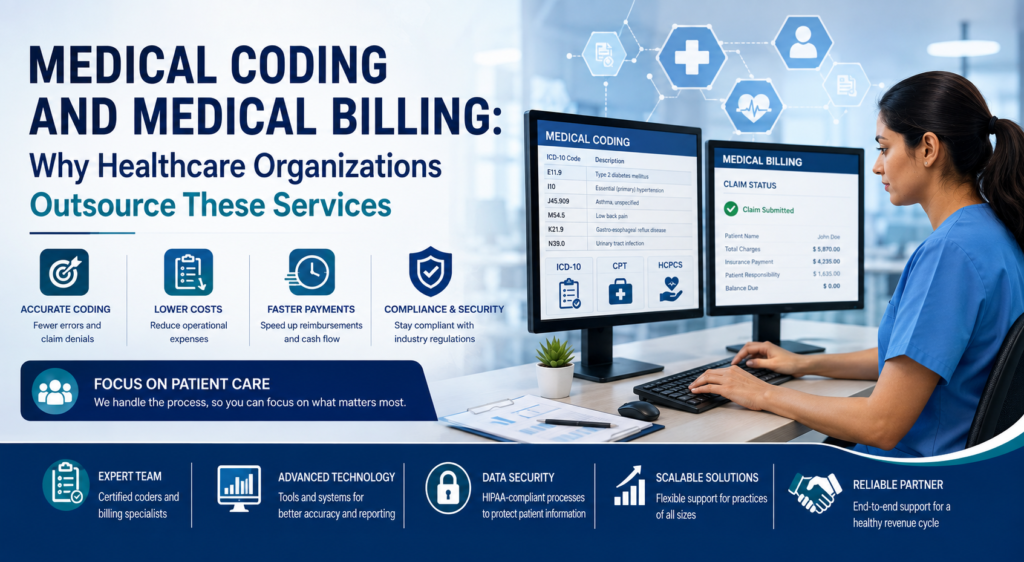
Medical coding is the process of converting information from clinical documentation into standardized medical codes.
Healthcare providers generate large amounts of clinical information during patient interactions. This information must be accurately translated into appropriate coding systems for billing, documentation, reporting, and administrative purposes.
Medical coding may involve coding systems such as:
- ICD-10
- CPT
- HCPCS
- HCC coding
- Procedure coding
- Diagnosis coding
Accurate coding is important because incorrect or incomplete coding can contribute to claim issues, reimbursement delays, reporting problems, and additional administrative work.
What Is Medical Billing?
Medical billing involves the financial and administrative processes associated with submitting and managing healthcare claims.
Depending on the organization’s workflow, medical billing activities may include:
- Patient information verification
- Insurance verification
- Charge entry
- Claim preparation
- Claim submission
- Payment posting
- Account reconciliation
- Denial management
- Appeals
- Accounts receivable follow-up
- Billing reports
The objective is to ensure that healthcare services are appropriately documented, billed, submitted, and followed up throughout the revenue cycle.
Why Are Healthcare Organizations Outsourcing Medical Coding and Medical Billing?
Healthcare organizations often outsource these functions because managing them internally can be resource-intensive.
The major reasons include:
1. Access to Specialized Expertise
Medical coding and billing require knowledge of healthcare documentation, coding standards, payer requirements, and billing workflows.
Outsourcing allows organizations to work with teams specifically trained for these processes rather than building every capability internally.
2. Improve Coding Accuracy
Accurate coding is essential for effective healthcare administration.
Coding errors can result in:
- Claim rejections
- Reimbursement delays
- Incorrect billing
- Additional administrative work
- Revenue leakage
A structured coding workflow with quality checks can help organizations maintain greater consistency.
3. Reduce Administrative Workload
Healthcare professionals should be able to focus on patient care rather than spending excessive time on administrative processes.
Outsourcing routine coding and billing activities can reduce the workload placed on internal administrative teams.
This allows healthcare organizations to allocate more resources toward:
- Patient services
- Clinical operations
- Patient communication
- Practice management
- Business development
4. Support Faster Claims Processing
Delays in claims processing can affect healthcare organizations’ cash flow.
A structured billing process can help ensure that claims are prepared and submitted efficiently.
The workflow may include:
Patient Information → Documentation → Coding → Charge Entry → Claim Submission → Payment Posting → Reconciliation
Efficient processing can help reduce unnecessary delays throughout the revenue cycle.
5. Reduce Operational Costs
Maintaining an internal medical coding and billing department can involve:
- Recruitment
- Salaries
- Training
- Software
- Infrastructure
- Management
- Quality assurance
- Continuous professional development
Outsourcing allows healthcare organizations to access specialized resources without necessarily maintaining the same level of internal infrastructure.
The focus should be on overall operational value, rather than simply choosing the lowest-cost provider.
Key Benefits of Medical Coding and Medical Billing Outsourcing
Improved Accuracy
Dedicated professionals and defined quality-control procedures can help improve consistency in coding and billing workflows.
Better Revenue Cycle Management
Efficient coding, billing, denial management, and accounts receivable follow-up can support healthier revenue cycle operations.
Scalability
Healthcare organizations can adjust outsourced resources according to changes in workload and business requirements.
Reduced Administrative Burden
Internal teams can spend more time on important organizational and patient-facing activities.
Faster Turnaround
Dedicated teams can process coding and billing workloads according to defined turnaround requirements.
Better Cost Management
Outsourcing can help organizations manage staffing and operational expenses more efficiently.
Access to Specialized Skills
Healthcare BPO providers can offer trained professionals with experience in coding and billing workflows.
Medical Coding Services
A healthcare outsourcing partner may support several coding-related activities, depending on project requirements.
ICD-10 Coding
Diagnosis information can be translated into appropriate ICD-10 codes based on clinical documentation.
CPT Coding
Procedures and services can be coded according to applicable CPT requirements.
HCPCS Coding
Healthcare procedures, supplies, and services can be processed using applicable HCPCS coding requirements.
HCC Coding
HCC-related coding and documentation processes can support risk-adjustment workflows.
Medical Record Review
Medical documentation can be reviewed to identify relevant coding information.
Coding Quality Assurance
Quality-control processes can be used to review coding accuracy and identify potential errors.
Medical Billing Services
Outsourced medical billing can cover multiple stages of the billing workflow.
Insurance Verification
Patient insurance information can be reviewed and verified according to the organization’s process.
Charge Entry
Relevant charges can be entered and prepared for billing.
Claim Submission
Claims can be prepared and submitted according to applicable workflows.
Payment Posting
Payments and adjustments can be recorded against appropriate accounts.
Denial Management
Rejected or denied claims can be reviewed to identify potential causes and determine appropriate follow-up.
Appeals
Eligible claims can be prepared for appeal according to the required process.
Accounts Receivable Follow-Up
Outstanding accounts can be monitored and followed up based on defined workflows.
Reporting
Billing and revenue-cycle reports can help healthcare organizations monitor operational performance.
Why Accuracy Matters in Medical Coding and Billing
Accuracy is particularly important in healthcare revenue-cycle processes.
A small documentation or coding error can create additional administrative work and potentially delay reimbursement.
An effective quality-control framework can include:
- Documentation review
- Coding verification
- Claim validation
- Error identification
- Quality audits
- Regular performance monitoring
The objective is to create a consistent process that reduces avoidable errors while maintaining appropriate documentation and coding standards.
Compliance and Data Security
Healthcare organizations handle sensitive patient and financial information, making data protection a critical consideration when selecting an outsourcing partner.
Before outsourcing healthcare processes, organizations should evaluate:
- Data-access controls
- Confidentiality procedures
- User permissions
- Secure file transfer
- Data storage practices
- Employee training
- Audit procedures
- Business continuity measures
- Applicable healthcare privacy requirements
Organizations should also establish clear contractual responsibilities and security expectations before transferring sensitive information.
Important: Healthcare organizations should independently verify that an outsourcing provider’s actual security controls and compliance certifications meet their specific regulatory and contractual requirements.
How Medical Coding and Billing Outsourcing Works
A typical outsourcing workflow can include the following stages:
Step 1 — Requirement Analysis
The healthcare organization defines its processes, volumes, systems, turnaround requirements, and quality expectations.
Step 2 — Process Mapping
The outsourcing team documents the workflow and responsibilities.
Step 3 — Team Allocation
Appropriate trained resources are assigned to the project.
Step 4 — Training and Knowledge Transfer
The team becomes familiar with the client’s workflow, systems, documentation requirements, and quality standards.
Step 5 — Coding and Billing
The assigned team performs the required coding and billing activities.
Step 6 — Quality Assurance
Processed work is reviewed against defined quality requirements.
Step 7 — Reporting
Performance metrics and operational reports are shared with the client.
Step 8 — Continuous Improvement
The workflow can be reviewed periodically to identify opportunities for improving productivity, accuracy, and turnaround time.
When Should a Healthcare Organization Consider Outsourcing?
Outsourcing may be worth evaluating when a healthcare organization is experiencing:
- Increasing claim volumes
- Coding backlogs
- Billing delays
- High administrative workload
- Difficulty recruiting specialized staff
- Increasing operational costs
- Seasonal workload fluctuations
- Denial-management challenges
- Need for scalable processing capacity
For growing healthcare organizations, outsourcing can provide an additional operational capacity without requiring immediate expansion of the internal team.
How to Choose the Right Healthcare BPO Partner
Selecting a healthcare outsourcing provider requires more than comparing prices.
Consider the following:
| Evaluation Area | What to Check |
|---|---|
| Healthcare Experience | Relevant healthcare process experience |
| Coding Expertise | Knowledge of applicable coding systems |
| Billing Capability | End-to-end billing workflow experience |
| Quality | Defined QA and auditing procedures |
| Security | Data protection and access controls |
| Technology | Suitable healthcare and billing systems |
| Scalability | Ability to handle changing workloads |
| Reporting | Clear operational and performance reports |
| Communication | Dedicated support and escalation process |
| Pricing | Transparent commercial structure |
A strong outsourcing partner should be able to explain how the process will work, how performance will be measured, and how sensitive healthcare information will be handled.
Why Healthcare Organizations Choose BPO Services
The healthcare industry continues to face pressure to deliver quality patient care while managing administrative complexity.
Outsourcing selected back-office functions allows organizations to create a division of responsibilities:
Healthcare Team
→ Focuses on patients and clinical operations
BPO Team
→ Supports coding, billing, documentation, and administrative workflows
This model can help organizations concentrate on their core healthcare activities while specialized teams manage designated administrative processes.
Healthcare Services at Nakshatra BPO Services
Nakshatra BPO Services includes Healthcare Services within its outsourcing portfolio, alongside Data & Publishing Services, Web Development, and BPO & Call Center Services. Its healthcare offering is positioned around medical coding and medical billing support. Explore Nakshatra BPO Services
For healthcare organizations evaluating outsourcing, the appropriate engagement should be based on the organization’s specific workflow, volume, systems, compliance requirements, quality expectations, and operational objectives.
Conclusion
Medical coding and medical billing are essential parts of the healthcare revenue cycle, but they can also create significant administrative demands.
Outsourcing these processes to an experienced healthcare BPO partner can help organizations pursue:
Better operational efficiency
Improved coding and billing accuracy
Reduced administrative workload
Faster processing
Scalable support
Better cost management
Stronger revenue-cycle operations
The right outsourcing strategy allows healthcare organizations to focus more attention on what matters most—delivering quality patient care—while specialized teams support important administrative processes behind the scenes.
Ready to Explore Healthcare BPO Services?
If your healthcare organization is looking for support with medical coding, medical billing, or related healthcare back-office processes, explore the healthcare services offered by Nakshatra BPO Services.
Nakshatra BPO Services
Your Growth. Our Process.
📞 +91 72599 22666 / +91 73377 88666
✉️ info@nakshatrabpo.com
🌐 nakshatrabpo.com
CTA: Discuss Your Healthcare Outsourcing Requirements


1 Comment
Neque porro quisquam est, qui is dolor emr ipsum quia dolor sit amet the consec tetur is adipisci velit, sed Neque porro.